Audiobook list · November 2026
Best Science Audiobooks: From the Big Bang to the Human Brain
The best science audiobooks make big ideas easy to follow by ear. There are no equations to work through, just good storytelling and narrators who keep you curious.
These picks cover the universe, the human body, genes and medicine, plus a few books that change how you see everything. All are well-rated on Audible. If you love the natural world, my list of the best nature audiobooks covers trees, fungi and wildlife.
By Peter Clemens · November 2026
Some links are affiliate links. I may earn a commission at no cost to you. How I make money.
If you only listen to three
A tour of everything, a war inside your body and the universe in an afternoon.
Space and the Universe
Black holes, the Big Bang and life beyond Earth.

Astrophysics for People in a Hurry
Tyson packs the big questions of the universe into short chapters you can finish on a commute: the Big Bang, dark matter, dark energy and the search for life on other planets. He reads it himself with real enthusiasm, and it is one of the quickest ways into modern astrophysics.

Cosmos
Carl Sagan’s classic companion to his TV series travels from the origins of the universe to the story of life on Earth and our place among the stars. LeVar Burton reads the main text, and the warmth of Sagan’s writing still comes through decades later.

Brief Answers to the Big Questions
Stephen Hawking’s final book takes on questions like whether there is a God, how the universe began and whether we can predict the future. Ben Whishaw reads most of it in a clear, gentle voice, and it is one of the most moving science listens out there.

Seven Brief Lessons on Physics
Seven short lessons cover relativity, quantum mechanics, black holes and the nature of time without a single equation. Rovelli reads it himself, and at under two hours it is the shortest pick on this list.

Packing for Mars
Mary Roach looks at the strange, practical side of sending people into space: what astronauts eat, how they cope with isolation and what happens to the human body without gravity. It is funny, curious and full of details you will want to repeat.
The Human Body and Brain
How your body works, why you behave the way you do and what happens when it breaks.

The Body
Bill Bryson tours the human body from head to toe, explaining how it works, how it fails and the people who figured it out. He reads it himself, and his dry humor makes even the gross parts a pleasure to listen to.

Immune
Philipp Dettmer, founder of the Kurzgesagt science channel, explains the immune system as a story of cells at war, from cuts and colds to allergies and cancer. It is the highest-rated pick here and makes a complicated subject easy to follow.

Behave
Robert Sapolsky explains why we do what we do by stepping back in time from a single action: the second before, the hours before, our childhood and finally evolution. It is long and detailed, but there is no better listen on the biology of human behavior.

Breath
Journalist James Nestor sets out to understand how we breathe and why so many of us do it badly, mixing research, history and his own experiments. He reads it himself, and you may find yourself breathing differently by the end.
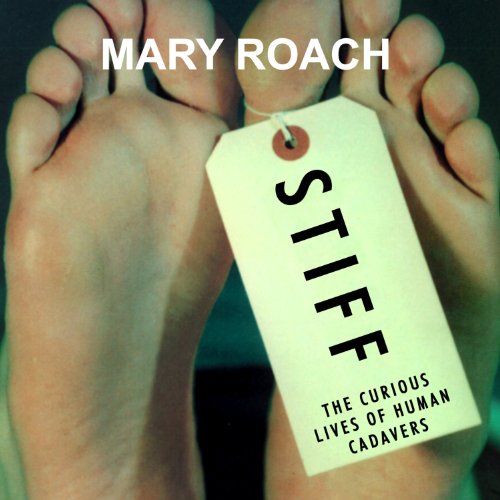
Stiff
Mary Roach’s first book follows what happens to bodies donated to science, from crash tests to surgical training. It sounds grim, but her curiosity and humor make it surprisingly respectful and very entertaining.
Life, Genes and Medicine
Evolution, genetics, viruses and the senses of other animals.

The Gene
Siddhartha Mukherjee tells the history of genetics from Mendel’s pea plants to gene editing, woven together with his own family’s history of mental illness. It is a big book, and Dennis Boutsikaris keeps it moving.

The Emperor of All Maladies
Mukherjee’s Pulitzer Prize-winning biography of cancer covers thousands of years of patients, doctors and scientists. This is a new 2025 recording read by Fred Sanders, so it has fewer ratings than the older editions.

The Selfish Gene
Richard Dawkins’s 1976 classic argues that evolution is best understood from the point of view of the gene. Dawkins and Lalla Ward share the reading, and it is still one of the most influential science books ever written.

An Immense World
Ed Yong explores how other animals sense the world, from birds that see ultraviolet light to fish that sense electric fields. He reads it himself, and it will change how you think about every animal you meet.

The Hot Zone
Richard Preston’s true story of Ebola, including an outbreak among research monkeys near Washington, D.C., reads like a thriller. It is tense and vivid, so it is not a bedtime listen for the squeamish.
Big Ideas for Curious Minds
Books that explain how science works and why it is so surprising.

A Short History of Nearly Everything
Bill Bryson set out to understand how we know what we know about the universe, Earth and life, and the result is the best general science audiobook there is. Richard Matthews reads the full version, and it has more ratings than any other pick here.

What If?
Randall Munroe, creator of the xkcd webcomic, answers absurd questions with real science, like what would happen if you threw a baseball at nearly the speed of light. Wil Wheaton reads it with perfect comic timing.

Chaos
James Gleick tells the story of chaos theory and the butterfly effect through the scientists who discovered order in weather, dripping taps and heartbeats. It is a classic of science writing that still feels fresh.

The Elegant Universe
Brian Greene explains string theory and the hunt for a theory of everything, building up from relativity and quantum mechanics. It is the most demanding pick here, but Greene is a gifted explainer.
Science audiobooks: common questions
Which science audiobook should I start with?
A Short History of Nearly Everything is the best all-round choice if you have about 18 hours. If you want something short, Astrophysics for People in a Hurry takes under four hours.
What are the shortest science audiobooks here?
Seven Brief Lessons on Physics runs 1 hour 45 minutes, Astrophysics for People in a Hurry 3 hours 41 minutes and Brief Answers to the Big Questions 4 hours 51 minutes.
Which are the best-rated?
Immune has 4.9 stars. Brief Answers to the Big Questions, An Immense World and The Emperor of All Maladies have 4.8, although The Emperor of All Maladies is a new recording with far fewer ratings.
Are science audiobooks hard to follow without diagrams?
Not these. They were written for general readers and explain things with stories and examples rather than charts. The Elegant Universe and Behave are the most demanding, so try a lighter pick first.
Can I listen to science audiobooks for free?
Many of these are available from your public library through the Libby app. My guide to free audiobooks covers Libby and other legal ways to listen without paying.
Where can I find more nonfiction audiobooks?
Try my lists of the best nature audiobooks, history audiobooks and memoir audiobooks. If you want science in story form, see the best hard sci-fi audiobooks.
Never run out of audiobooks to listen to
One email a week: the best current audiobook deals and one editor’s pick.
